
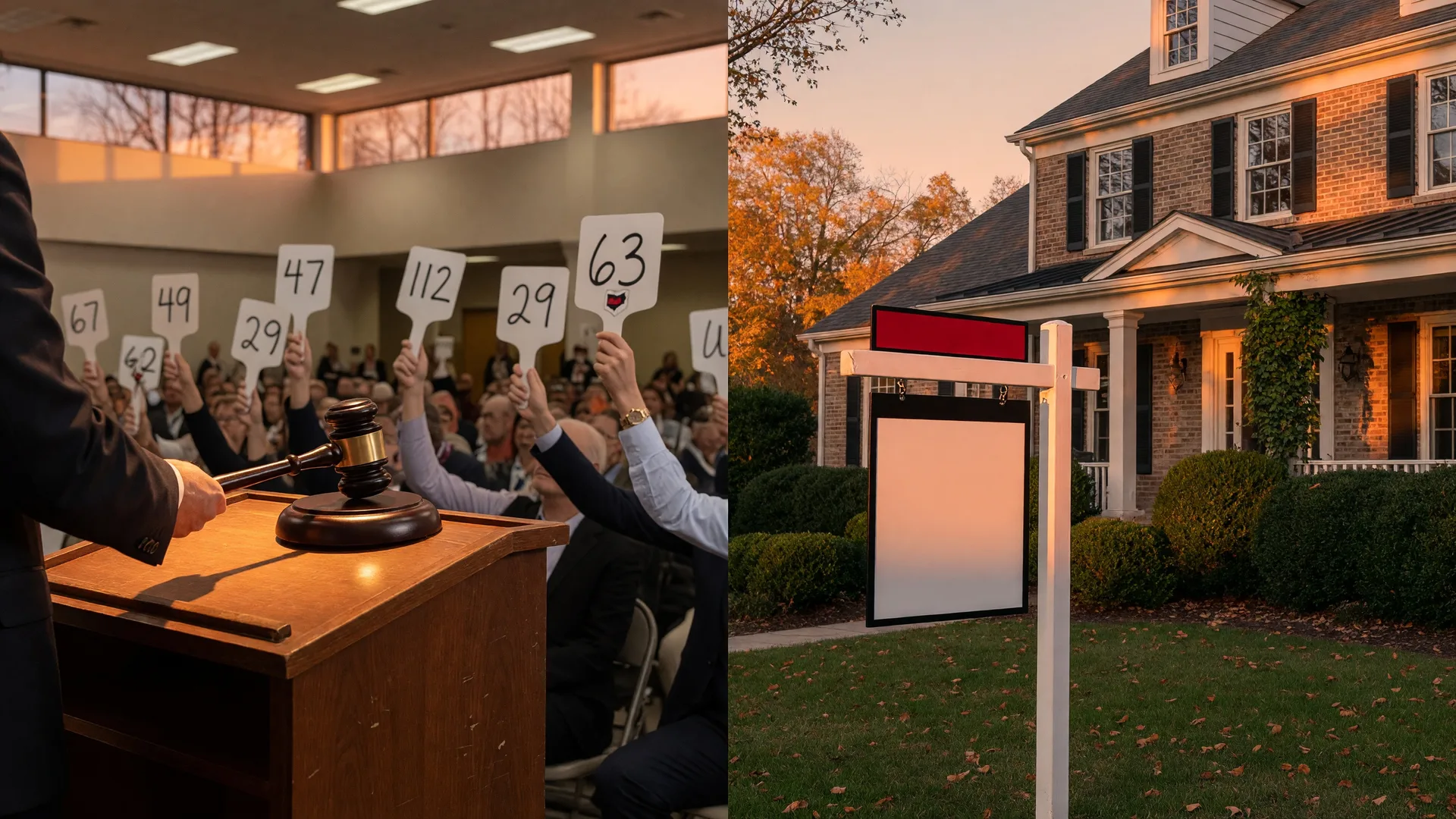
"Auctions create a competitive environment that often results in a sale price at or above fair market value. The process is transparent, the timeline is defined, and the seller remains in control throughout."
National Auctioneers Association
Watch: Auction vs Traditional Listing
Quick Comparison
Before diving into the details, here is a side-by-side look at how auction and traditional listing compare across the factors that matter most to sellers.
Ohio's statewide median sales price reached $278,000 in May 2026, up 4.8% from $265,000 one year earlier (source: Ohio REALTORS). The National Association of Realtors reported the national median existing-home price at $440,600 in June 2026 (NAR). Auction campaigns typically run 45 to 60 days from start to closing, while a traditional listing in the $1M+ range often takes 3 to 12 months.
| Factor | Auction | Traditional Listing |
|---|---|---|
| Sale Timeline | 45-60 days | 3-12 months |
| Price Discovery | Market decides through competitive bidding | Seller sets asking price, buyer negotiates |
| Seller Costs | Auction marketing fee, no commission until sold | 5-6% commission (split between agents) |
| Buyer Motivation | Very high (competition, deadline) | Variable (may include lowball offers) |
| Transparency | Public, competitive, transparent | Private negotiations |
| Risk of No Sale | Reserve price protects seller | Can sit on market for months |
| Closing Certainty | Contract signed on auction day | Dependent on buyer financing/appraisal |
| Best For | Estates, luxury, unique properties, motivated sellers | Standard sales, flexible timeline |
When Auction Is the Better Choice
Auction selling is not right for every property, but it is often the stronger choice in specific situations. Here are the scenarios where auction delivers the best results.
Estate and Probate Sales
Estate properties come with unique challenges. The executor needs to settle the estate within a timeframe, manage personal property alongside real estate, and demonstrate fair market value to beneficiaries. An auction provides a clear, documented process that satisfies all parties. The defined timeline helps executors move forward without the uncertainty of an open-ended listing. For a deeper look, see our guide on selling an estate property in Northeast Ohio.
Luxury Properties Above $1M
High-value properties often have limited comparable sales, making it difficult to set a confident asking price. Auction lets the market determine the value through competitive bidding among qualified buyers. This approach works especially well for luxury homes in Westlake, Rocky River, Bay Village, and other Northeast Ohio communities where $1M+ properties attract a national audience.
Unique or Unusual Properties
Properties that do not fit a standard buyer profile -- historic homes, architect-designed houses, hobby farms, waterfront estates, or properties with mixed-use potential -- can be hard to price using traditional comparable sales. An auction brings together buyers who specifically value what makes your property unique, and they compete to pay what it is worth to them.
Distressed Properties
When a property needs repairs or updates that would make it difficult to attract traditional buyers, an auction can be the most efficient path to sale. Buyers who attend auctions expect to purchase properties as-is, which eliminates the need for costly pre-sale renovations.
Divorce Situations
Divorce sales demand clarity, fairness, and a firm timeline. An auction provides a neutral process where the market determines the price, removing the emotional back-and-forth of private negotiations. Both parties know the outcome on auction day, which allows everyone to move forward.
Business Liquidations
When a business needs to convert commercial real estate, equipment, inventory, or vehicles into cash, an auction can handle everything under one coordinated plan. Our commercial auction services cover the full range of business assets.
Motivated Sellers Who Need a Defined Timeline
Some sellers simply need to know the exact date their property will sell. Whether you are relocating for a job, retiring to another state, or coordinating a move around a specific date, an auction campaign gives you a defined end date that you can plan around.
When Traditional Listing Is the Better Choice
Traditional listing is the right approach for many sellers. Here is when it makes the most sense.
Standard Homes in Active Markets
If your property fits a well-defined buyer profile and the local market has strong demand at your price point, a traditional listing may be the simplest path. The MLS distribution network gives your property broad exposure, and as long as the price is right, qualified buyers will find it.
Sellers with Flexible Timelines
If you are not in a hurry to sell and can wait for the right offer, a traditional listing gives you the flexibility to hold out for the price and terms you want. You can wait for the market to bring the right buyer rather than setting a fixed auction date.
Properties in High-Demand Neighborhoods
In neighborhoods where multiple offers are common, a traditional listing can generate its own competitive environment. A well-priced property in a desirable area may attract several offers within the first few weeks, achieving a similar result to an auction without the auction format. For more on this, read about how to price a $1M+ home in Northeast Ohio.
What About the Cost?
Cost is one of the most common questions sellers ask when comparing auction and traditional listing. Here is a transparent look at how the two approaches compare.
In a traditional listing, the seller typically pays a 5-6% commission split between the listing agent and the buyer's agent. On a $1M property, that is $50,000 to $60,000 in commission. The seller also pays for marketing, photography, staging, and other preparation costs.
In an auction, the seller pays an auction marketing fee that covers the full campaign: professional photography, videography, digital marketing, print materials, signage, and the auction event itself. There is no commission until the property sells. In many cases, the auction approach costs less than the combined commission of a traditional listing, while achieving a faster result.
The key difference is that auction costs are known upfront and bundled into the marketing fee, while traditional listing costs are uncertain and depend on how long the property sits on the market. For a closer look at timelines, see how long it takes to sell a luxury home in Northeast Ohio.
How the Auctioneer's Role Differs
A real estate agent and an auctioneer serve different roles, and understanding the difference helps you choose the right professional for your situation.
A listing agent markets your property, manages showings, negotiates offers, and guides you through the transaction. They are a facilitator and advisor, waiting for buyers to come through the door.
An auctioneer is simultaneously the marketer, event producer, and deal closer. The auctioneer plans and executes a full campaign designed to attract qualified buyers to a specific event on a specific date. They manage the bidding process, enforce the terms, and close the sale on auction day. The auctioneer's compensation is tied to results -- if the property does not sell, there is no commission.
As a licensed auctioneer with CAI, AARE, and AMM designations, I bring both skill sets. Whether you choose auction or traditional listing, you get an advisor who understands both paths and can recommend the one that fits your situation. Learn more on our about page and services page.
Real Results
While every property is different, the auction approach has delivered strong results for sellers across Northeast Ohio. Here is a typical example of how auction selling works in practice.
Example: Luxury Estate in Westlake, Ohio
A 5-bedroom, 5,200-square-foot estate on a prime lot in Westlake needed to sell within 60 days. The property had unique architectural features that made it hard to price using standard comparable sales. The seller chose an auction approach with a reserve price.
- Marketing campaign: 45 days
- Qualified bidders: 8 registered
- Final sale price: Exceeded reserve by 12%
- Closing: 30 days after auction
Not every property sells above reserve, and not every auction draws multiple bidders. But the structure of the auction process -- defined timeline, competitive bidding, and qualified buyers -- gives sellers the best chance at a strong outcome. For more on how auctions work step by step, visit our how auctions work page.
Frequently Asked Questions
Is selling at auction really faster than listing?
Yes. A typical auction campaign runs 45 to 60 days from start to closing. A traditional listing in the $1M+ range often takes 3 to 12 months from listing to closing. The auction timeline is defined from day one, while a traditional listing has no guaranteed end date. For a detailed breakdown, see how long it takes to sell a luxury home in Northeast Ohio.
What if my property does not sell at auction?
You set a reserve price, which is the minimum amount you are willing to accept. If bidding does not reach the reserve, the property does not sell. At that point, you can choose to negotiate with the highest bidder, switch to a traditional listing, or try another auction at a later date. The reserve price protects you from being forced to sell below your minimum.
Do buyers pay more at auction?
Competitive bidding often drives the price at or above fair market value. When multiple qualified buyers compete for the same property, they bid against each other rather than against the seller's asking price. The result is a market-driven price that reflects what buyers are actually willing to pay -- not what a seller hopes to get or what an appraiser estimates.
Can I still negotiate at an auction?
Yes. Before the auction, you set the terms, including the reserve price, closing timeline, and any conditions. If the high bid meets your reserve, the sale is final. If the high bid is below reserve, you can negotiate directly with the highest bidder after the auction. The auction process gives you multiple paths to a successful outcome.
How do I know if auction is right for my property?
The best way to find out is to have a conversation about your specific situation. I evaluate each property on its own merits -- the local market conditions, your timeline, your goals, and the property's unique characteristics. There is no one-size-fits-all answer, and I offer both auction and traditional listing services. If you want to learn more about the auction process, visit our FAQ page or how auctions work page.
Not Sure Which Is Right for You?
Contact John Froelich to discuss your property, your timeline, and your goals. We will look at your specific situation and recommend the approach that gives you the best outcome.