
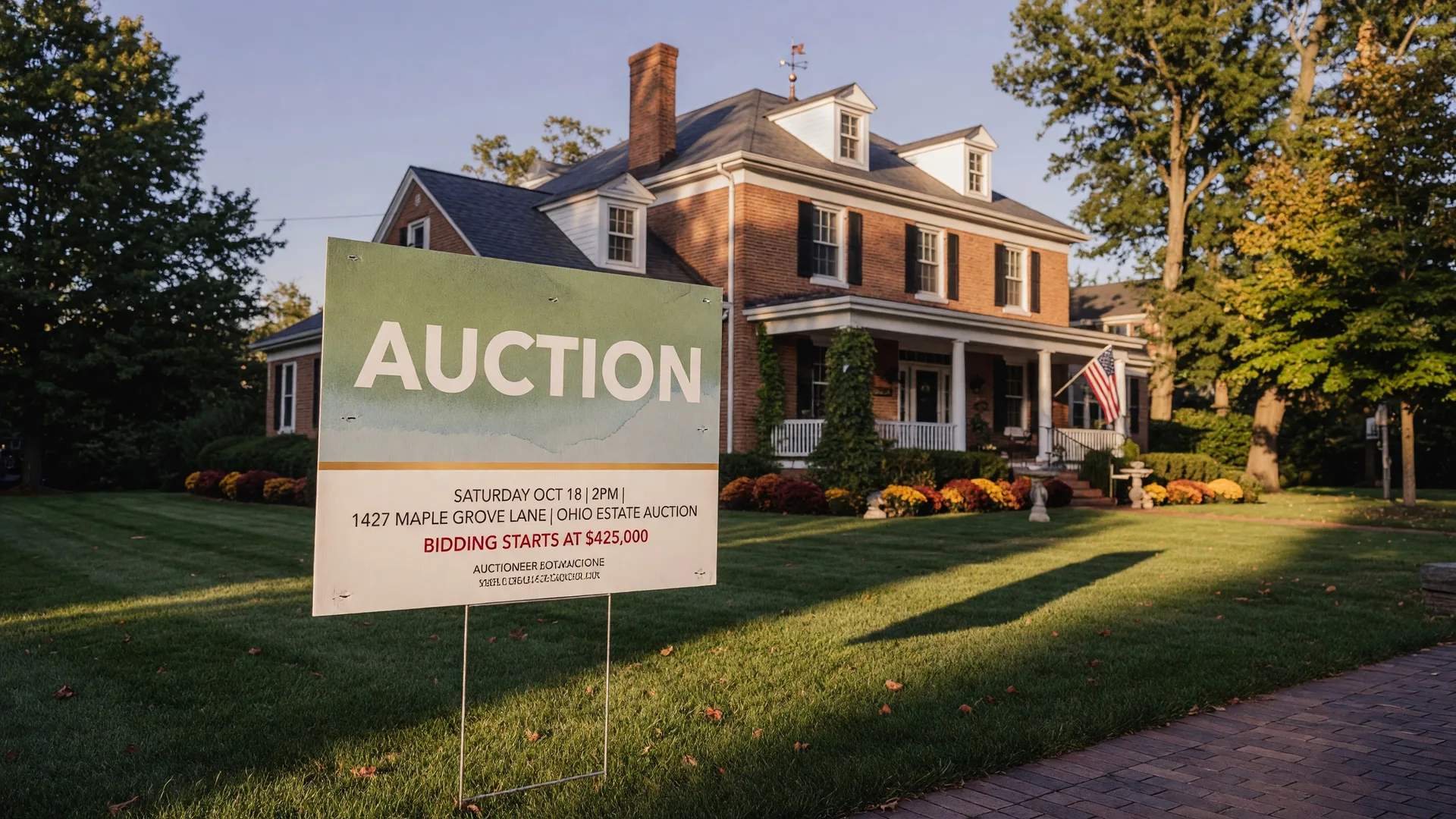
If you are considering selling your home at auction in Ohio, the first question on your mind is probably about cost. How much does it actually cost to auction a house? The short answer is: less than you might think, and often significantly less than a traditional real estate commission. But the full answer depends on your property type, the auction structure you choose, and the scope of the marketing campaign.
Here is a transparent breakdown of what auction costs look like in Ohio, how they compare to traditional listing expenses, and what you get for your money.
How Auction Fees Are Structured
Unlike a traditional real estate listing, where the seller pays a percentage-based commission (typically 5-6% split between the listing agent and buyer's agent), auction fees are structured differently. Most professional auctioneers in Ohio charge a flat marketing fee upfront, plus a performance-based commission only if the property sells.
There are two common fee structures:
Flat Marketing Fee Model. The auctioneer charges a flat fee that covers the full marketing campaign, event management, and closing coordination. This fee is typically paid at the start of the campaign. If the property sells, the auctioneer receives a small commission on top. If it does not sell (because bidding did not reach your reserve price), the marketing fee covers the work already done, and there is no additional commission owed.
Commission-Only Model. Some auctioneers forgo the upfront marketing fee and instead charge a higher commission only when the property sells. This model is less common for luxury properties because the marketing campaign requires significant upfront investment in photography, videography, digital advertising, and event logistics.
In either model, the seller sets the reserve price, which is the minimum amount they are willing to accept. This protects the seller from being forced to sell below their floor. For more on how reserve prices work, see our how auctions work page.
Cost Comparison: Auction vs Traditional Listing
To understand the cost difference, it helps to see the numbers side by side. Here is a comparison table for a $1M property in Northeast Ohio.
| Cost Item | Auction | Traditional Listing |
|---|---|---|
| Marketing/Preparation | $5,000 - $15,000 flat fee | $2,000 - $5,000 (photography, staging, materials) |
| Commission | $5,000 - $15,000 (performance-based, only if sold) | $50,000 - $60,000 (5-6% of sale price) |
| Buyer's Premium (paid by buyer) | 5-10% of winning bid (standard) | N/A |
| Total Seller Cost (estimated) | $10,000 - $30,000 | $52,000 - $65,000 |
| Timeline to Sale | 45-60 days | 3-12 months |
| Carrying Costs (taxes, utilities, insurance) | Minimal (short timeline) | $10,000 - $40,000+ (extended timeline) |
| Closing Certainty | High (contract signed on auction day) | Moderate (depends on financing, inspections) |
As the table shows, the total cost to the seller using auction can be significantly lower than a traditional listing, especially when you factor in the carrying costs of holding a property for months while waiting for a buyer. For more detail on how the two approaches compare, see our full auction vs traditional listing comparison.
What the Marketing Fee Includes
One of the most common misconceptions about auction marketing fees is that they cover only an auction listing on a single website. In reality, a professional auction marketing campaign includes a comprehensive set of services designed to attract the broadest possible pool of qualified buyers.
Here is what a typical auction marketing fee covers:
- • Professional photography and videography: High-resolution interior and exterior photos, aerial drone footage, and walkthrough video tours
- • Digital advertising: Targeted campaigns on Google, Facebook, Instagram, and real estate portals reaching qualified buyers in your price range
- • MLS distribution: Full listing on the local multiple listing service, ensuring all cooperating agents and their clients see the property
- • Signage and print materials: Professional auction signage, brochures, and property information packets
- • Event management: Open houses, preview events, and the auction day itself, including bidder registration, auctioneer services, and onsite staff
- • Buyer qualification: Screening of bidders to ensure they are financially qualified and able to close on the property
- • Closing coordination: Contract preparation, title company coordination, and post-auction closing support
For luxury properties in communities like Westlake, Rocky River, and Bay Village, the marketing campaign often includes additional services such as targeted outreach to luxury buyer networks and premium placement on high-end real estate platforms.
Hidden Costs to Watch For
While auction costs are generally more transparent than traditional listing fees, there are a few potential costs that sellers should be aware of before committing to an auction.
Buyer's Premium. The buyer's premium is a percentage added to the winning bid, paid by the buyer. This is standard in the auction industry and typically ranges from 5% to 10%. While the buyer pays this fee, it can affect the maximum bid they are willing to make. An experienced auctioneer will factor this into the marketing and reserve strategy.
Property Preparation Costs. Unlike a traditional listing, where sellers often spend thousands on staging, renovations, and repairs, auction properties can sell as-is. However, basic preparation such as deep cleaning, decluttering, and addressing any safety issues may still be worthwhile. The auctioneer will advise on what is necessary.
Legal and Title Fees. Both auction and traditional sales involve standard closing costs, including title insurance, recording fees, and attorney fees. These are not unique to auction and apply to any real estate transaction in Ohio.
Withdrawal or Postponement Fees. If you decide to withdraw the property from auction after the marketing campaign has begun, you may be responsible for the costs incurred to date. Most auction agreements include a provision for this. The best practice is to make the decision to auction before the campaign starts, not after.
The most important thing to know is that a reputable auctioneer will provide a detailed written cost proposal before any work begins. You will know exactly what you are agreeing to pay, and there should be no surprises. For more on what to expect, visit our real estate auction services page.
Is Auction Cost-Effective for Your Property?
The answer depends on your property value, timeline, and goals. Here is a quick framework to help you decide.
Auction is likely cost-effective if: Your property is valued at $500,000 or more, you need to sell within a defined timeline (60-90 days), the property is unique or difficult to price using comparable sales, or you want to avoid the uncertainty of a drawn-out listing process.
Traditional listing may be more cost-effective if: Your property is in a high-demand market with strong buyer activity, you have flexibility on timing, and the property fits a standard buyer profile that the MLS can easily reach.
For luxury properties in the $1M+ range, the savings from auction can be substantial. A traditional commission of $50,000 to $60,000 on a $1M property far exceeds the typical auction marketing fee and performance commission combined. And when you factor in the carrying costs of a 6-12 month traditional listing, the gap widens further.
Communities like Avon, Avon Lake, Strongsville, and Brunswick have seen growing interest in auction sales as homeowners recognize the cost and timeline advantages. The National Auctioneers Association reports that auction sales consistently achieve fair market value while reducing seller carrying costs.
What About Lower-Value Properties?
For properties valued under $300,000, the math can be different. The marketing fee may represent a larger percentage of the sale price, and the auction model may not provide the same cost advantage. However, even for lower-value properties, auction can be the right choice when speed, certainty, or a unique property type are the primary concerns. The best approach is to discuss your specific situation during a free consultation.
According to the National Auctioneers Association, the auction industry transacts billions of dollars in real estate annually, and auction is increasingly recognized as a mainstream selling method, not a niche alternative. Ohio's auction laws are well established, and licensed auctioneers are regulated by the Ohio Department of Agriculture.
The Bottom Line on Auction Costs
Selling a house at auction in Ohio typically costs less than selling through a traditional real estate listing, especially for higher-value properties. The fee structure is transparent, the costs are known upfront, and you do not pay a commission until the property sells. The marketing fee covers a comprehensive campaign that includes professional photography, digital advertising, MLS distribution, and full event management.
The initial consultation is always free, and there is no obligation to move forward. If you are curious about what auction would cost for your specific property, the best next step is to have a conversation. You will receive a detailed proposal that spells out every cost, so you can make an informed decision.
For a deeper understanding of the auction process, our services page explains both the auction and traditional listing approaches. The FAQ page also addresses common questions about costs, timelines, and the auction process.
Frequently Asked Questions
How much does an auctioneer charge to sell a house in Ohio?
Most Ohio auctioneers charge a flat marketing fee ranging from $3,000 to $15,000, plus a performance-based commission of 1-3% if the property sells. The total cost is typically far less than the 5-6% commission charged in a traditional listing. The initial consultation is always free, and you receive a detailed written proposal before any work begins.
Are auction fees tax deductible?
Auction fees, like real estate commissions, are generally considered selling costs and can reduce the capital gain on the sale. For primary residences, the IRS allows a $250,000 capital gains exclusion ($500,000 for married couples). Consult your tax professional for advice specific to your situation.
What happens if my house does not sell at auction?
If bidding does not reach your reserve price, the property does not sell. You are not charged a commission. The marketing fee covers the work already done. You can then negotiate with the highest bidder, switch to a traditional listing, or try another auction at a later date. The reserve price protects you from being forced to sell below your minimum.
Does the buyer pay any fees at an Ohio real estate auction?
Yes. The winning bidder typically pays a buyer's premium of 5-10% on top of the winning bid. This is standard practice in the auction industry and is disclosed in the auction terms. The buyer's premium is separate from the seller's costs and is clearly stated before bidding begins.
How do auction costs compare for a luxury home in Westlake, Ohio?
For a $1M+ property in Westlake or nearby communities like Rocky River or Bay Village, the total auction cost is typically $10,000 to $30,000, compared to $50,000 to $60,000 in traditional listing commissions. The savings are even larger when you factor in the carrying costs of a 6-12 month traditional listing timeline.
Ready to Learn What Auction Would Cost for Your Property?
Contact John Froelich to discuss your property, your timeline, and your goals. You will receive a detailed cost proposal with no obligation. Auctions work, and the first step is a conversation.
Best wishes,
John C. Froelich, CAI, AARE, AMM